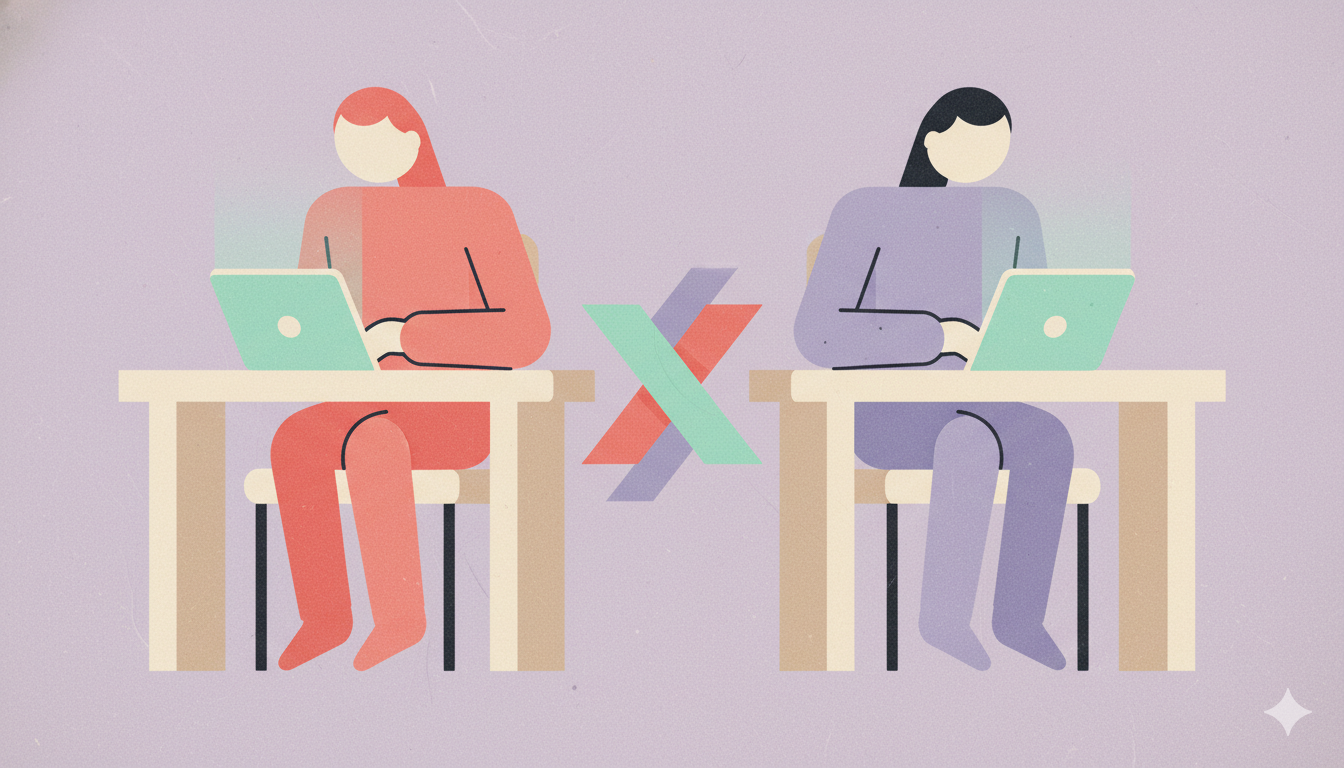
There's a reason I could do homework in the library but not in my bedroom. Why I'd spend an entire day "working from home" and accomplish nothing, then be productive for 4 hours straight at a coffee shop. Why cleaning the apartment felt impossible alone but easy when my partner was home.
The reason has a name: body doubling. And once I understood it, I finally stopped fighting my brain and started working with it.
What Body Doubling Actually Is
Body doubling is exactly what it sounds like - having another person present while you work. They don't need to help you. They don't even need to do the same task. They just need to be there, existing in the same space, doing their own thing.
It sounds too simple to work. But for ADHD brains, that presence does something powerful: it provides external regulation that our internal regulation systems can't.
Think of it like this. Neurotypical brains have a little internal supervisor that keeps them on track - notices when they're drifting off task, generates motivation to keep going, maintains awareness of time passing. ADHD brains have a supervisor who shows up randomly, takes three-hour lunch breaks, and sometimes doesn't come to work at all.
Another person's presence acts as a borrowed supervisor. Not through nagging or checking in, but just through existing. Their quiet focus creates a kind of productive pressure. Their presence makes the task feel more real, more immediate, more possible.
The Convert Launch
When I started building Convert, I knew it would be a long project. Six months minimum of sustained work - designing, coding, testing, iterating. The kind of project that requires showing up day after day, even when there's no deadline and no one's watching.
For an ADHD brain working solo? That's basically impossible.
I'd tried everything before. Website blockers (I'd disable them). Accountability apps (I'd ignore the notifications). Self-imposed deadlines (future-me didn't care about past-me's promises). Nothing could make me show up consistently when I was alone.
Then I discovered Focusmate.
Focusmate Changed Everything
Focusmate is a video coworking service. You book 50-minute sessions, get matched with a stranger, say what you're working on, and then... work. Cameras on, mics muted, both of you doing your own tasks in companionable silence.
I was skeptical. Working over video with random people sounded awkward and gimmicky. But I was desperate, so I tried it.
The first session was a revelation. I'd been putting off a task for three days. Within five minutes of the session starting, I was working on it. The stranger on my screen wasn't doing anything special - just sitting there, typing away at their own project. But their presence made my task feel achievable in a way it hadn't before.
I finished the task in that session. Three days of avoidance, 40 minutes of actual work.
Over the next six months, I logged over 400 Focusmate sessions. That's roughly 330 hours of guaranteed productive time, sessions where I showed up and actually worked instead of spinning in procrastination spirals.
Convert shipped. I genuinely don't think it would have without those sessions.
Other Virtual Options
Focusmate isn't the only option. The body doubling community has exploded in the last few years, and there are tons of ways to access it:
Flow Club is similar to Focusmate but with more community features and group sessions. Some people prefer the slightly more social vibe.
Discord servers for coworking have popped up everywhere. Search for "study with me" or "coworking" servers and you'll find spaces where people stream themselves working, sit in voice channels together, or just exist in shared virtual spaces while being productive.
"Study with me" livestreams on YouTube are a passive version. Not as effective as real-time interaction, but having someone on screen working can help. I use these when Focusmate slots aren't available.
Informal arrangements with friends. I have a few friends who are also self-employed. We'll text "coworking session?" and hop on a Zoom, cameras on, doing our own work. No pressure, no checking in, just parallel presence.
Making It Work
A few things I've learned about body doubling:
It works better when you commit to what you'll work on. Saying "I'm going to write the settings screen for my app" out loud at the start of a Focusmate session creates a micro-commitment that makes starting easier.
Camera on matters. I've tried audio-only coworking and it's significantly less effective. Something about being seen - even by a stranger who isn't watching - adds accountability that audio doesn't.
Consistency beats intensity. Three scheduled sessions per day, every workday, did more for me than occasional marathon sessions. The habit of showing up became automatic.
It's okay to do boring tasks. Body doubling isn't just for creative work. I've used Focusmate sessions for emails, expense reports, cleaning my apartment, making phone calls I've been avoiding. The presence helps with everything.
The Point
I spent years feeling ashamed that I couldn't work alone. Everyone else seemed to manage it. Successful people talked about their morning routines and focused work blocks like it was easy, like you just... decided to work and then did.
Body doubling helped me accept that my brain needs different conditions. And that's not a weakness to overcome - it's just information about how to set myself up for success.
If you struggle to work alone, you're not lazy. Your brain might just need witnesses. Try it.