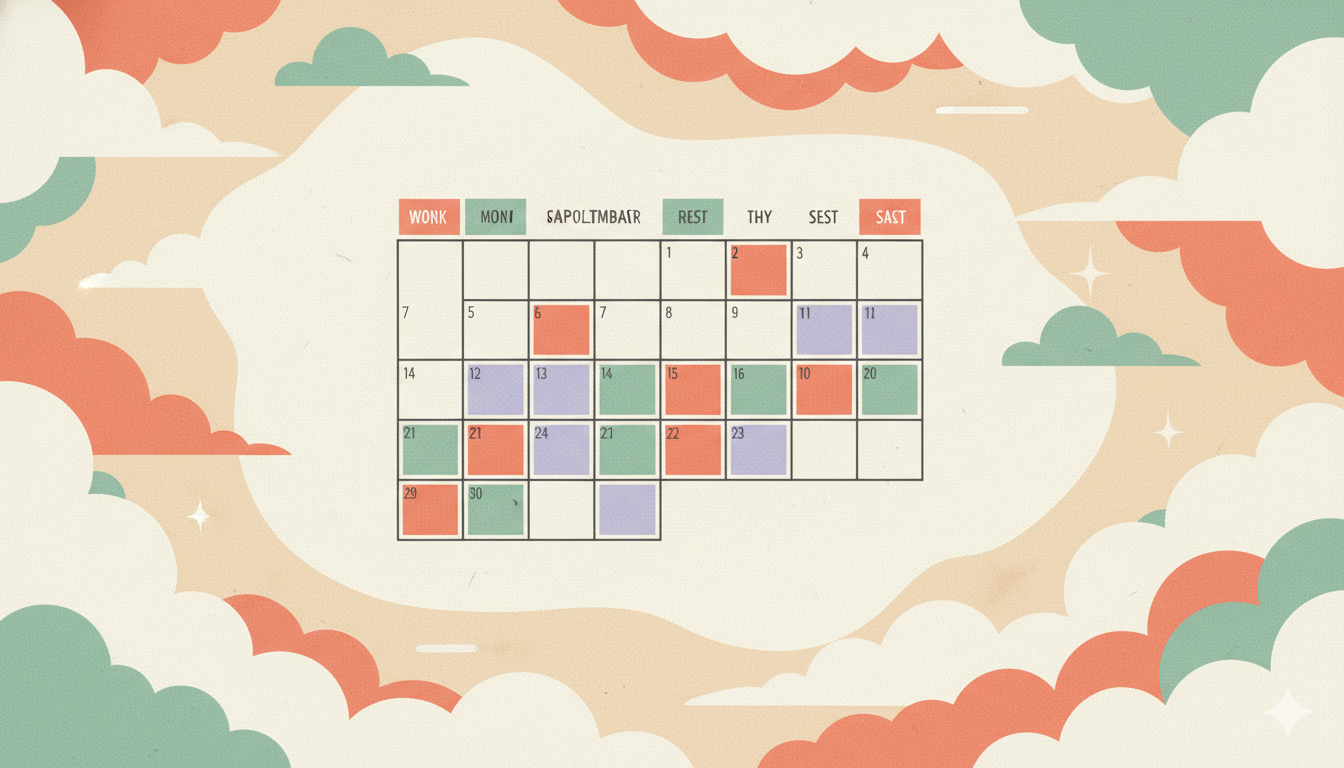
"Have you tried using a calendar?"
I can't count how many times I've heard this. From friends, family, therapists, productivity articles. As if the problem is that I simply hadn't considered writing things down. As if I'd just never encountered the concept of scheduling.
I've used calendars. Google Calendar, Apple Calendar, Fantastical, Calendly, paper planners, wall calendars, desk calendars. The problem isn't access to calendars. The problem is that calendars, as typically designed, assume a neurotypical brain.
The Hidden Assumptions
Here's what a standard calendar assumes about its user:
You'll remember to check it. This is the big one. Calendars are passive tools - they sit there holding information until you look at them. But ADHD brains struggle with prospective memory, which is remembering to do things in the future. I can set up a perfect calendar and then not open it for three days straight because I forgot it exists.
You can translate abstract time blocks into action. Looking at "Project work 2-4pm" on a calendar and actually starting project work at 2pm are completely different cognitive tasks. The calendar tells me what should happen. It doesn't help me make it happen. There's a gap between information and execution that calendars don't bridge.
You have accurate time perception. I wrote about time blindness in another post, but it's relevant here too. Calendars represent time as neat little blocks, but I don't experience time as neat little blocks. I experience it as elastic, unreliable, inconsistent. What looks like "plenty of time" on a calendar feels very different in the moment.
Text is enough. Most calendars are primarily text-based. Event names, descriptions, maybe a tiny colored dot. But ADHD brains often process visual and spatial information more readily than text. A wall of text events doesn't communicate urgency or importance - it's just noise.
What Actually Fails
When I used to rely on Google Calendar alone, here's what would happen:
I'd set up events carefully. Then I'd get absorbed in something and not look at my phone for four hours. The reminder would fire, I'd dismiss it while focused on something else, and the event would pass without me ever consciously registering it.
Or I'd see an event coming up - "Dentist at 3pm" - but the abstract future-ness of 3pm wouldn't translate into action. I'd keep doing whatever I was doing, convinced I had plenty of time, until suddenly it was 2:55 and I needed to leave ten minutes ago.
Or I'd open my calendar, see a packed day of time blocks, feel instantly overwhelmed by all that text, and close the app without actually processing any of the information.
The calendar was doing its job. My brain just couldn't interface with it properly.
Visual Planning That Actually Works
After years of failed calendar systems, I've landed on a combination that works better. Not perfectly - nothing works perfectly - but better.
Physical whiteboard with the week. I have a large whiteboard in my office with seven columns, one for each day. Important things get written there in different colored markers. Red is urgent. Blue is work. Green is personal. The physicality matters - I see it every time I look up from my desk. I can't accidentally close it or dismiss a notification.
Aggressive calendar reminders. Not one reminder - minimum three. I set reminders for 1 day before, 2 hours before, 30 minutes before, and 10 minutes before for anything important. The first few are "start thinking about this" reminders. The last one is "seriously stop what you're doing."
Color coding everything. In my digital calendar, every type of event has a distinct color. Meetings are blue. Deadlines are red. Personal stuff is green. Focus time is purple. My brain can glance at a day and instantly see the texture of what's coming without reading any text.
Time blocking with buffer. If I have a meeting at 2pm, I don't just put the meeting in my calendar. I put a block from 1:30-2pm called "PREP: [meeting name]" and another block after for "POST: debrief/notes." The meeting event itself doesn't help me prepare for or recover from it - I need those explicitly scheduled too.
Alarm clock for deep work. When I need to do focused work and then stop for something else, I set a literal alarm - the kind that makes noise across the room that I have to physically walk to and turn off. Phone notifications are too easy to dismiss automatically.
Saying appointments out loud. This sounds weird but it helps. When I schedule something, I say it out loud: "Dentist Thursday at 3." The verbal processing creates a different kind of memory trace than just typing it into a calendar.
The Redundancy Principle
Here's what I've learned: for ADHD brains, one system is never enough. Any single point of failure will eventually fail. What you need is layered redundancy - multiple overlapping systems so that when one doesn't catch you, another does.
My whiteboard might not save me if I don't look up. But the calendar reminders will ping. If I dismiss those without thinking, the alarm clock will go off. If I somehow miss that, the text I sent myself the night before might help. Something usually catches me.
This sounds exhausting because it is. Neurotypical people don't need five redundant reminder systems for a dental appointment. But neurotypical people also don't have the executive function deficits that make single systems unreliable.
We work with the brain we have, not the brain we wish we had.
For the Advice-Givers
If someone you know struggles with scheduling and time management, "just use a calendar" isn't helpful advice. They've almost certainly tried calendars. The issue isn't lack of tools - it's that standard tools don't account for their specific cognitive differences.
More helpful: asking what's already been tried, what specifically fails, and what might help address those specific failures. Or just offering support without unsolicited advice. That works too.
Because the answer to "why don't you just use a calendar" is: I do. It's just not enough.