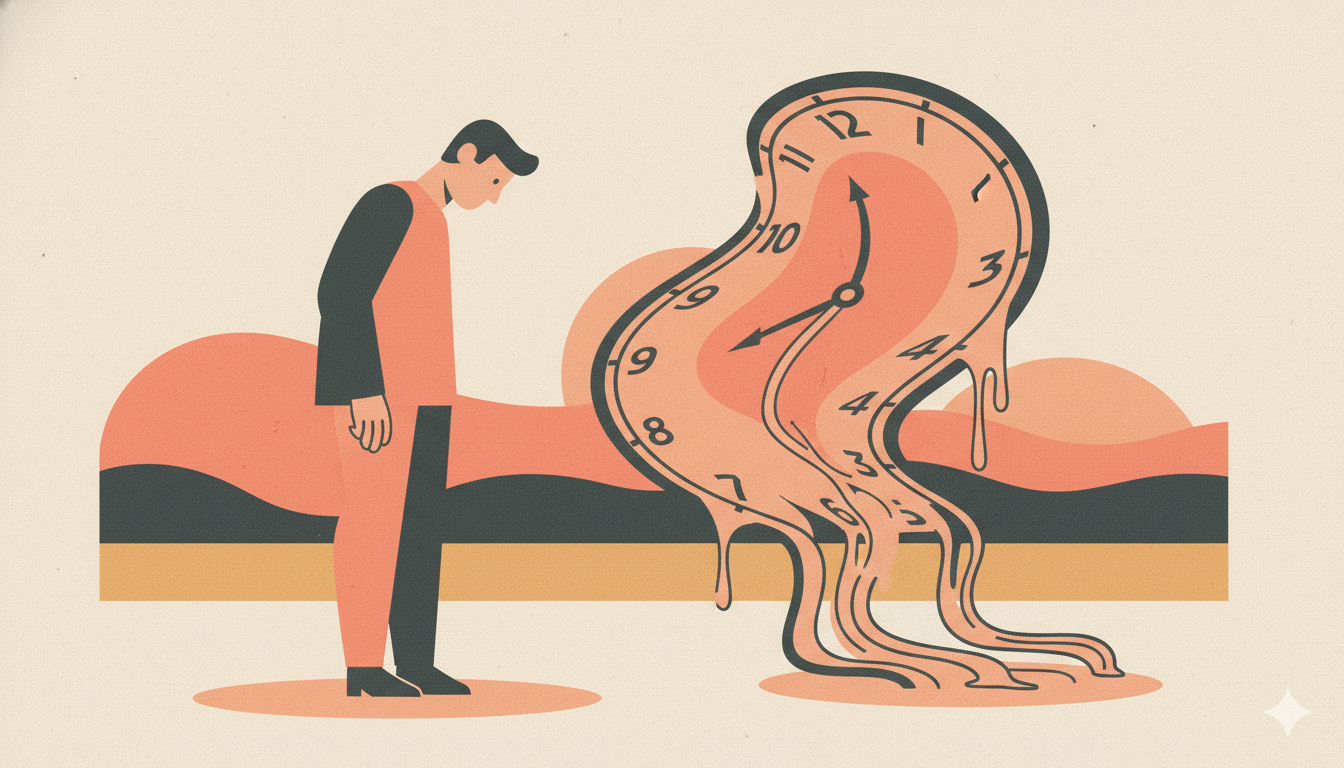
Last Tuesday I sat down to "quickly check Twitter" at 10am. The next time I looked at a clock, it was 1:47pm. Nearly four hours had vanished. I hadn't eaten, hadn't noticed I needed to use the bathroom, hadn't registered that an entire morning had disappeared.
This happens to me constantly. It's not carelessness. It's not laziness. It's called time blindness, and for a long time I thought I was just broken.
What's Actually Happening in Your Brain
Neurotypical brains have a kind of internal clock. Not a perfect one, but functional. They can roughly sense how long something has taken, estimate how long something will take, and maintain some background awareness of time passing even while focused on other things.
ADHD brains? That clock is unreliable at best, completely offline at worst.
Research has shown that people with ADHD consistently underestimate how much time has passed and how long tasks will take. Dr. Russell Barkley, one of the leading ADHD researchers, describes it as "temporal myopia" - a near-sightedness to time. We live in an eternal now, unable to feel the approach of future deadlines or the weight of passing minutes.
This isn't metaphorical. Brain imaging studies show differences in how the prefrontal cortex and cerebellum - regions involved in time perception - function in ADHD brains. The internal mechanisms that track time simply don't work the same way.
The Two Faces of Time Blindness
Prospective time blindness is about the future. How long will this task take? You genuinely don't know. That "quick errand" that took three hours? You weren't lying when you said it would be quick. You believed it. Your brain has no reliable way to simulate future time.
This is why I'm constantly late. Not because I don't care, but because I genuinely cannot feel how long 30 minutes is, or how long getting ready actually takes, or how much time I need to leave for commuting. Every single time, I'm surprised that it took as long as it did.
Retrospective time blindness is about the present melting away. You're doing something, and time stops registering entirely. Hours compress into what feels like minutes. You emerge from a task to find the day is gone, genuinely shocked at how much time has passed.
I've missed flights because of this. Missed entire meetings I was supposedly waiting for. Let food burn because I stepped away "for a second" and lost an hour.
Workarounds That Actually Help
Since my internal clock is broken, I have to build external ones. It's annoying. It sometimes feels excessive. But it works.
Multiple obnoxious alarms. Not one reminder - at least three for anything important. I use my phone, my Apple Watch, and sometimes a physical timer I can't silence from across the room. The first alarm is a warning, the second is a "seriously stop now," and the third is "you're already late."
Visible countdowns. I have a Time Timer - one of those visual timers where a red disc shrinks as time passes. It sounds childish, but being able to see time disappearing makes it more real than just numbers on a clock. There are apps that do this too, like Visual Timer or Time Timer's own app.
The "getting ready" calendar event. If I have a 10am meeting, I don't just put the meeting in my calendar. I put a 9am event called "STOP EVERYTHING - PREPARE FOR MEETING." And another at 9:30 called "YOU SHOULD BE WRAPPING UP NOW." It looks ridiculous but it's the only way I'm on time.
Absurd buffer time. I've learned to multiply my time estimates by at least 2.5. If I think something will take an hour, I block three hours. I'm often wrong by that much anyway. This isn't pessimism - it's acknowledging that my time estimates are fantasies.
Time anchors. I try to connect tasks to external events that have fixed times. "I'll work on this until the laundry is done" (the machine will beep). "I'll keep going until my 2pm reminder" (not "for about an hour"). These external anchors substitute for the internal sense of time I don't have.
The Shame Factor
Here's the hard part. Time blindness causes real problems - missed appointments, disappointed friends, failed deadlines. And because other people can't see the disability, they assume you just don't care.
I used to believe them. I thought I was selfish for being late, lazy for missing deadlines, disrespectful of other people's time. The shame was constant.
Learning that this is a documented neurological difference didn't make the problems go away. But it helped me stop hating myself for them. I'm not a bad person who can't be bothered to show up on time. I'm a person with a specific disability who needs specific accommodations.
That shift - from moral failing to manageable condition - changed everything. I still struggle. But I struggle with self-compassion now, and that makes it possible to keep trying instead of giving up.
Telling Other People
I've started being upfront about this with friends and colleagues. "I have ADHD and time blindness is one of my symptoms. I might need extra reminders for things. I'm not being disrespectful if I'm late - I literally cannot feel time pass normally."
Most people are understanding when you explain it. Some aren't, and that's okay too. But at least I'm not carrying the lie that I'm just careless or that I don't value their time.
Because I do value their time. I just can't perceive it.